Event Circle Mastery: WordPress launch support and PHP troubleshooting
My work on Event Circle Mastery involved go-live assistance and PHP troubleshooting for a WordPress website using Elementor. The business introduces coaching, events, and a community-oriented offering associated with Jessica Stewart and Erica Maurer. Its website gives visitors a place to learn about the people behind the brand, explore event information, and find supporting content.
The engagement focused on the practical technical work around publishing a site and resolving runtime issues. That work sits at the point where a website needs to move from an editable presentation into a public business resource. I approached it with the relationship between the technical environment and the visitor experience in mind.
Business overview and website purpose
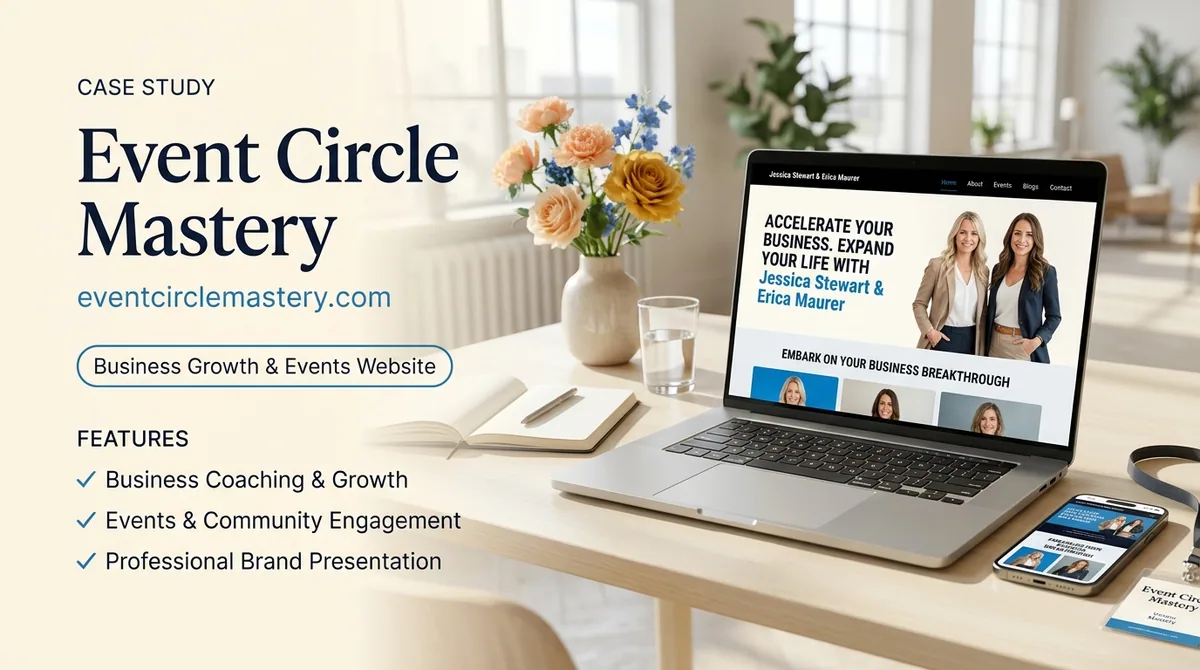
Event Circle Mastery presents business coaching and event experiences for entrepreneurs. Its public content discusses business development, mindset, networking, and community. The homepage introduces Jessica Stewart and Erica Maurer, followed by information about their professional backgrounds and event-related offering.
The website needs to establish both a personal connection and a clear business context. Visitors may want to understand the coaches, investigate an event, or read supporting material before deciding to contact the team. The site’s main destinations give those questions a recognizable place.
Project goals and my contribution
My contribution centered on launch support and PHP-related troubleshooting within the WordPress and Elementor environment. The goal was to address the technical issues involved in bringing the website online and support its public-facing role.
Launch work requires attention to the interaction between the application environment and the pages visitors expect to reach. A layout may be editable in a builder, but the public website also depends on the server-side behavior that delivers it. My approach connects those layers so troubleshooting remains tied to the site people actually use.
I focused on the engagement’s practical purpose: helping an event and coaching business establish its website as an accessible source of information. Technical support at this stage is valuable because it addresses the conditions under which the content and interface are delivered.
Content structure and public functionality
The navigation provides Home, About, Events, Blogs, and Contact. This compact structure reflects the principal visitor journeys without requiring an extensive menu. The homepage introduces the brand and its people, while the separate destinations create room for more detailed business and event information.
Individual profile sections explain the backgrounds of the two central personalities. Event-related sections introduce named experiences, and the wider page includes speaker information, testimonials, and blog links. These content types give visitors different ways to explore the offering, from understanding the brand to learning about its community context.
The content hierarchy therefore has a clear sequence: introduction, people, opportunities, and supporting material. That structure is relevant to launch support because the public website needs to deliver several kinds of content within a consistent experience.
Design and user experience
The public presentation uses a high-contrast header, prominent navigation labels, and large headings. Blue accents highlight the central names and separate content areas, while a light background gives the text-heavy presentation room to explain the offering.
For a coaching and events business, the people behind the brand are an important part of the introduction. The page gives the founders dedicated sections rather than reducing them to a short footer biography. Event and community content then expands the proposition beyond those individual introductions.
My technical approach considers this hierarchy when working through runtime issues. The website’s purpose is carried by the relationship between its content sections and destinations, so technical troubleshooting needs to remain connected to those public journeys.
Development approach: WordPress, Elementor, and PHP
WordPress provides the website environment, while Elementor supports the page presentation. PHP forms part of the server-side context relevant to the troubleshooting work. My engagement brought these concerns together around the practical requirements of going live.
I approach runtime troubleshooting by keeping the expected page behavior central. The useful question is how a technical issue affects the website’s ability to present information or support navigation. This helps keep the work focused on the business resource being delivered rather than treating the technical environment as an unrelated layer.
Launch support also benefits from a clear understanding of the existing site structure. The main pages, content sections, and visitor routes provide a framework for checking the public experience as technical work progresses. For Event Circle Mastery, that framework is the coaching and events journey presented through the website.
For related work, explore my WordPress development services and PHP development services. My Bullerbekämparen case study provides another example of technical support within an established WordPress environment.
Conclusion
Event Circle Mastery represents my work on the technical side of launching and supporting a WordPress and Elementor website. The project connects PHP troubleshooting and go-live assistance with the practical needs of a coaching and events business. Visit the Event Circle Mastery website for its current business presentation.