Falcon Diesel: a service website redesign with a clear quotation journey
My work on Falcon Diesel involved improvements to an existing website through a multi-page redesign and quotation functionality. The business provides specialized mechanical services for power generation, commercial marine, mining, and civil industries. The website needs to communicate that technical offering clearly while giving equipment owners and business teams a practical way to describe their requirements.
I approached the project around the connection between service discovery and enquiry. A visitor should be able to recognize the relevant industry, investigate the service, and contact the team without having to navigate unrelated information. The redesign and quote journey work together to support that progression.
Business overview and service context
Falcon Diesel operates from a Brisbane workshop and presents both workshop-based work and mobile mechanical services. Its homepage describes support for power generation, commercial marine, and mining or civil equipment, with service information that connects each area to a more detailed destination.
This is a specialist audience with practical questions about equipment, maintenance, repairs, and service locations. A marine operator may have a different requirement from a civil contractor or a business managing power-generation equipment. The website therefore needs clear service groupings rather than a single broad description of mechanical work.
The public presentation also provides company background, gallery information, location details, and a separate parts destination. These routes give visitors more context as they evaluate whether the business is suitable for their needs.
Project goals and multi-page structure
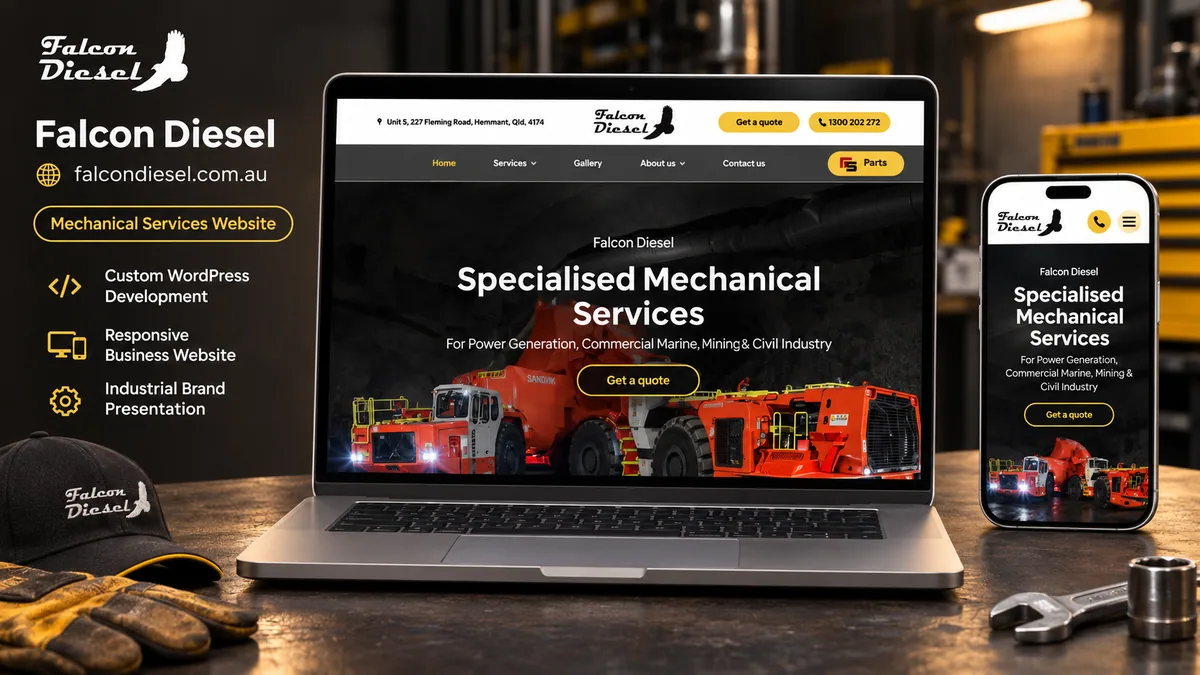
My redesign work focused on making the website’s service pathways and enquiry options easier to understand. The main navigation introduces Services, Gallery, About Us, and Contact Us, while the homepage links into Power Generation, Commercial Marine, and Mining/Civil information.
This hierarchy separates the business’s overall introduction from the detail of an individual service area. Someone arriving with a defined need can move into a relevant destination, while a visitor still researching can read the company introduction and compare the main service categories.
For a multi-page redesign, consistency matters across those routes. Headings, actions, and navigation should remain recognizable as visitors move through the site. My approach keeps the service content connected to the wider identity and the same practical next step: discussing the work required.
Quotation functionality and contact options
The quote action appears prominently in the header and opening presentation. It opens an enquiry panel with fields for name, email, contact number, and a message. The panel also provides direct email and telephone information, giving visitors several ways to continue the conversation.
This is an enquiry-based quote journey suited to specialist services. A prospective customer can describe a requirement rather than trying to select a fixed-price product. The message field gives the business room to understand the situation before discussing the appropriate service.
The homepage also includes a contact form farther down the page. Repeated enquiry opportunities support different levels of readiness: some visitors want to contact the team immediately, while others need to read the service descriptions and location information first. My work connects those actions with the content that helps people decide to use them.
Design and user experience
The desktop presentation uses a white upper header, a darker navigation strip, and strong yellow accents. The logo and contact information establish the business identity, while yellow quote and telephone treatments make the main communication options recognizable.
The hero combines industrial equipment imagery with a dark overlay and a centered service message. This places the business within its specialist mechanical context before the page expands into individual service areas. A lighter content area follows, giving longer explanations and supporting photography a distinct place.
The service sections combine headings, descriptive paragraphs, and links to more detail. This is useful for a technical offering because the reader needs more than an image to understand relevance. The visual presentation supports the service information while keeping the quote route available.
My development approach
I approached the redesign as a connected website experience rather than a collection of isolated page changes. The homepage introduces the service range, detailed destinations expand it, and the quote functionality provides a common route from interest to enquiry. That relationship guides the structure and interaction choices.
The quotation interface also needs to fit the business model. Mechanical service requirements vary by equipment, location, and the kind of work needed. An open enquiry gives customers a way to explain those details while keeping the initial interaction straightforward.
My work brings the multi-page presentation and quotation workflow together around those practical requirements. The goal is a professional website where service information and contact opportunities reinforce one another.
Explore my website development services for comparable service-business projects. My Evergreen Remodeling & Roofing case study offers another example of connecting specialist services with a quote-focused visitor journey.
Conclusion
Falcon Diesel combines specialist mechanical information with clear service categories and a practical quotation route. My redesign and enquiry work connects the business presentation with the needs of customers investigating repairs, maintenance, and on-site support. Visit the Falcon Diesel website to explore its current service offering.